


Most movers and junk removal companies aren’t losing business because of slow crews or wrong prices. They’re losing it before a potential customer ever sees their name. Moving company SEO is one of the most competitive local SEO categories in the country. Businesses that don’t show up in the map pack aren’t just missing clicks. They’re handing jobs to whoever does show up.
According to IBISWorld, the U.S. moving services industry reached a market size of $23.4 billion in 2025, spread across more than 9,100 businesses. That’s a lot of trucks chasing the same searches.
This post breaks down exactly why moving companies and junk removal companies get buried in “near me” searches, which local SEO gaps are doing the most damage, and what it actually takes to reach the local pack.
Key Takeaways:
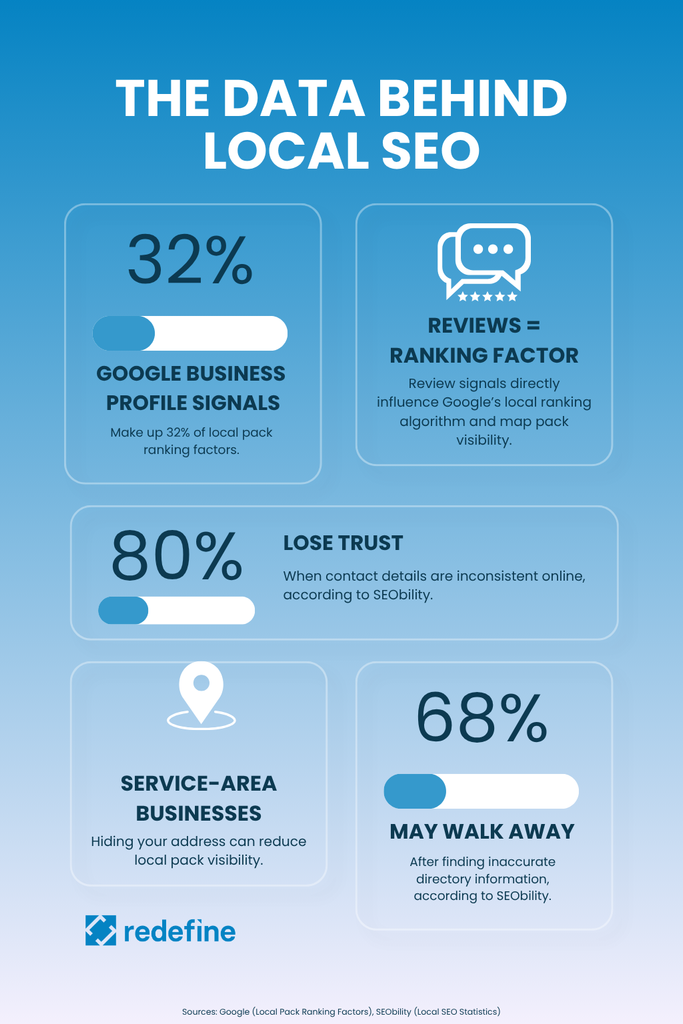
- Google Business Profile signals make up 32% of local pack ranking factors, making a complete, optimized profile the single highest-leverage asset for movers and junk removal companies.
- Review signals are a direct ranking input in Google’s local algorithm, not just a trust signal. That means reputation management has real consequences for map pack placement.
- Service-area businesses that hide their address, as Google requires, face reduced local pack visibility. Every other profile signal has to work harder to compensate.
- According to SEObility, 80% of customers lose trust in a local business when they see inconsistent contact details online, and 68% say they’d stop using a business entirely after finding inaccurate directory information.
Why “Near Me” Searches Are So Competitive for This Category
The moving and junk removal space sits at a tough intersection: high purchase intent, low brand loyalty, and a search results page dominated by the map pack. When someone types “movers near me” or “junk removal near me,” they’re ready to book. That urgency is exactly what makes this category so crowded and so hard to crack.
The Scale of the Competition
According to Cube Creative Design’s 2024 local SEO statistics, there are roughly 5.9 million “near me” keywords in the U.S., generating around 800 million searches per month. Moving companies and junk removal businesses compete inside that volume every single day, against national aggregators, franchise chains, and dozens of local operators all targeting the same zip codes.
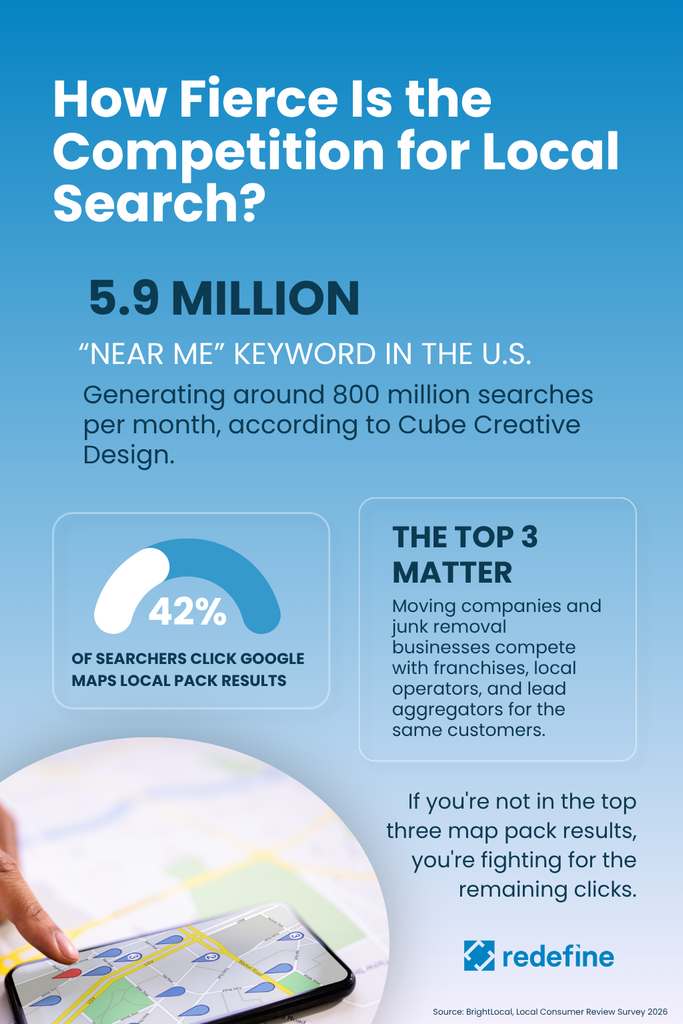
What makes it harder is where the clicks go. A 2024 study cited by SHNO.co found that 42% of searchers click on Google Maps local pack results for local queries. If your business isn’t in the top three map pack positions, you’re competing for the remaining clicks with organic listings that are often dominated by lead aggregators like Thumbtack, Angi, and HomeAdvisor. Those platforms are essentially buying your customers before you ever get a chance to talk to them.
Why This Category Is Especially Review-Driven
Moving is a high-stakes, high-anxiety purchase. People are trusting strangers with everything they own. Junk removal is lower stakes, but it still involves letting someone onto your property. Both categories trigger the same consumer behavior: heavy review research before booking.
According to SHNO.co’s 2026 local SEO statistics, 76% of “near me” mobile searches lead to a store visit or booking within 24 hours. That speed of decision-making means consumers aren’t doing deep research. They’re scanning customer reviews fast, looking for a reason to trust or a reason to skip. A thin review profile or a string of unanswered complaints is enough to send them to the next result.
According to Google’s Business Profile Help documentation, local results are primarily based on relevance, distance, and prominence. Businesses with complete and accurate information are more likely to appear. “Prominence” is partly determined by what Google knows about a business from across the web, including reviews. In a category where every competitor targets the same geography, customer reviews become one of the few meaningful differentiators.
The Specific Local SEO Gaps That Keep Movers Off Page One
Here’s what we see consistently when we audit moving and junk removal companies that can’t crack the local pack: the problems aren’t random. They cluster around a handful of structural gaps that make each other worse.
Gap 1: An Incomplete or Misconfigured Google Business Profile
According to the BrightLocal 2024 Local Search Ranking Factors report, Google Business Profile signals account for 32% of local pack ranking factors. That’s the single largest category. Yet most moving companies treat their profile as a one-time setup task rather than an active marketing asset.
The configuration challenge is specific to this industry. Google’s official Business Profile guidelines state that service-area businesses should hide their business address from customers, and that the service area boundary shouldn’t extend farther than roughly two hours of driving time from the business’s base. Many movers either leave their address visible, which violates guidelines and can trigger suppression, or set their service area so broadly that Google doesn’t associate them strongly with any specific location.
Hiding the address also creates a secondary problem. According to Local Falcon’s research on service-area business profiles, hiding an address can reduce local pack visibility, making every other profile signal more critical. And according to MyReputation.ie’s 2026 guide to Google Business Profile for service-area businesses, these businesses are significantly more vulnerable to spam edits than storefront businesses, precisely because there’s no shopfront photo to validate them as a real, operating business. Competitors or bad actors can suggest edits that change your category, phone number, or service area, and Google may apply them automatically.
Gap 2: Inconsistent NAP Citations Across the Web
NAP citations refer to your business name, address, and phone number. For service-area businesses, the address is often hidden. But the name and phone number still need to be consistent everywhere they appear: Yelp, Angi, the BBB, local chamber directories, and dozens of data aggregators that feed into Google’s understanding of your business.
Moz’s Local Search Ranking Factors study identifies citation signals, including directory NAP consistency and citation volume, as a key grouped ranking factor for local search. The stakes for getting this wrong are high. According to SEObility’s analysis of local SEO ranking factors, 80% of customers say they lose trust in local businesses when they see inconsistent contact details or business names online, and 68% say they’d stop using a local business entirely after finding inaccurate information in online directories.
Moving companies often change phone numbers, rebrand, or operate under a trade name that differs from their legal entity. Each variation creates a citation conflict that dilutes local authority.
Gap 3: A Thin or Absent Review Profile
The BrightLocal 2024 report places review signals at 20% of local pack ranking factors. That’s not a soft trust metric. That’s a direct ranking input. Yet many moving companies have fewer than 20 Google reviews, and a significant portion of those go unanswered.
The problem is structural. Moving is a transactional, one-time service for most customers. There’s no natural reason to come back and leave a review a week later. Companies that don’t have a systematic post-job review request process simply don’t accumulate reviews at the rate their competitors do.
Gap 4: Weak On-Page SEO and Missing Service Pages
The BrightLocal report places on-page SEO signals at 15% of local pack ranking factors. For most moving and junk removal websites, this is where things fall apart. We regularly see sites with a single homepage targeting every service in every city, no dedicated service pages for long-distance moves, commercial moves, or specialty item handling, and no location-specific content at all.
Keyword research for this category reveals clear intent differences. Someone searching “apartment movers [city]” has different needs than someone searching “office relocation company near me.” A single homepage can’t serve both queries well. Dedicated service pages with location-specific content, proper title tags, and schema markup give Google the signals it needs to match your pages to the right searches.
Technical SEO issues compound this. Slow mobile load times, missing schema markup, and poor internal linking are common across moving company websites. These aren’t glamorous fixes, but they’re foundational to search rankings.
Gap 5: No Content Strategy to Build Topical Authority
Most moving company websites have no blog, no FAQ content, and no resources that answer the questions their customers are actually searching. Questions like “how much does it cost to move a 2-bedroom apartment” or “what items can junk removal companies not take” represent real search volume. They’re opportunities to build organic traffic and topical authority that supports local rankings.
Content marketing in this category doesn’t need to be elaborate. A consistent library of helpful, locally relevant blog content signals to Google that this business is an active, authoritative resource in its market. Without it, moving companies are entirely dependent on their Google Business Profile and NAP citations, which limits how far they can go.
How to Close the Gap and Compete in Local Search
The good news is that most of these gaps are fixable. The moving and junk removal companies that dominate their local markets aren’t doing anything exotic. They’re executing the fundamentals better than everyone else.
Optimize Your Google Business Profile Like It’s Your Homepage
Your Google Business Profile is often the first thing a potential customer sees. Treat it accordingly. That means selecting the most specific primary category available, writing a description that includes your core moving services and service area naturally, uploading photos of your trucks and crew regularly, and keeping your service area set to the geography you can actually serve within roughly two hours of driving time, as Google’s guidelines specify.
Monitor your profile for unauthorized edits. Because service-area businesses have no shopfront photo to validate them, spam edits to your phone number or primary category can go unnoticed and hurt your visibility overnight. Check your profile at least once a month.
Build a Review Acquisition System, Then Work It
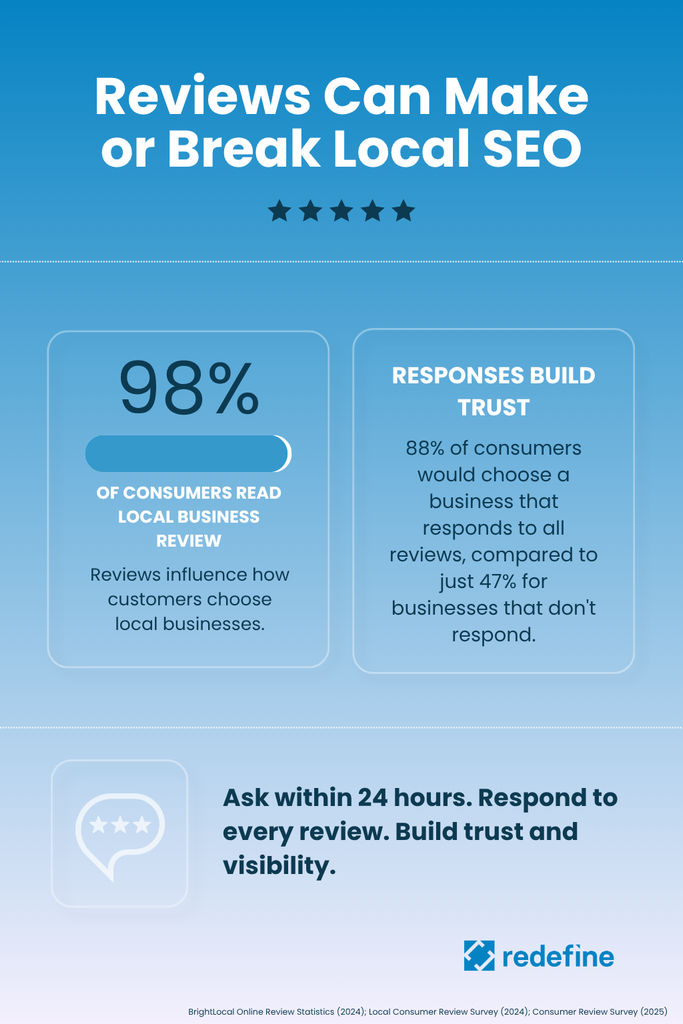
Reviews aren’t just a trust signal. They’re a ranking factor. According to BrightLocal’s 2024 online review statistics, 98% of people at least occasionally read online reviews for local businesses, and review signals account for 20% of Google Maps local pack ranking factors.
The fix is a post-job review request workflow: a text or email sent within 24 hours of job completion, with a direct link to your Google review page. Timing matters. Customers are most likely to leave a review when the experience is fresh and the relief of a completed move is still present.
Responding to reviews matters just as much as collecting them. BrightLocal’s Local Consumer Review Survey 2024, conducted with 1,141 U.S. consumers, found that 88% of consumers will choose a business that responds to all customer reviews, compared to just 47% who would choose a business that doesn’t respond at all. BrightLocal’s 2025 Consumer Review Survey also found that 89% of consumers expect business owners to respond to both positive and negative reviews, and 83% use Google specifically to read those reviews.
Responding to a negative review professionally, especially one about a damaged item or a late arrival, demonstrates accountability in a way that a string of five-star reviews alone can’t.
Fix Your NAP Consistency and Citation Footprint
Audit every directory where your business appears and standardize your name, phone number, and any address information. If you’ve rebranded or changed your number, this cleanup is non-negotiable. Redefine Marketing Group’s listing management service can systematically identify and correct citation inconsistencies across the major aggregators and directories that feed into Google’s local data.
For junk removal companies operating under a trade name that differs from their LLC name: pick one version and use it everywhere. Google’s algorithm treats name variations as separate entities, which splits your citation authority.
Build Service Pages and City Pages That Actually Rank
Every core service deserves its own page: local moving, long-distance moving, commercial moving, packing services, junk removal, appliance removal, and so on. Each page should target the specific long-tail keywords that match that service’s search intent, include location signals naturally in the copy, and carry proper on-page SEO elements including title tags, meta descriptions, header structure, and schema markup.
If you serve multiple cities or neighborhoods, city pages built around genuine local content (not just the city name swapped into a template) can extend your reach into surrounding markets. Our complete guide to local search engine optimization covers the structural approach to building these pages in a way that earns rankings rather than triggering thin-content penalties.
Use Blog Content to Build Authority and Capture Research-Phase Traffic
Customers who are three weeks out from a move are searching very different questions than those who are booking today. Blog content targeting research-phase queries, such as moving checklists, cost guides, and neighborhood comparisons, builds topical authority that strengthens your overall local SEO profile and captures moving leads earlier in the decision process.
This is also where link building becomes possible. A genuinely useful moving guide can earn links from local news sites, neighborhood blogs, and real estate resources in a way that a service page never will. Those links contribute to the 8% of local pack ranking factors attributed to link signals in BrightLocal’s 2024 report.
Need Showing Up in ‘Near Me’ Searches?
An experienced SEO team like Redefine Marketing Group can help businesses struggling to break into Google’s rankings with a managed growth strategy and flawless execution. Click here to contact us and get a free audit.