



A 4-star rating used to be enough. It signaled quality, built trust, and set you apart from the low-rated businesses at the bottom of the page. But home service reviews SEO has moved well past the star score. Today, a plumbing company with a 3.9-star average and 40 recent reviews can beat a competitor sitting at 4.2 stars with reviews that stopped coming in eight months ago. The click goes to the business that looks active, responsive, and trusted right now. Not the one that looked great last year.
This post breaks down why star ratings alone no longer win the click, and which signals actually separate the business that gets called from the one that gets scrolled past.
Key Takeaways:
- A 4-star rating no longer clears the bar for a large share of potential customers. Consumer expectations have risen fast, and review volume matters just as much as the score itself.
- Review velocity, the rate at which new reviews arrive, tells Google your business is active. A stagnant review profile hurts local search rankings even when your star average looks fine.
- Old positive reviews erode trust rather than build it. Most consumers only consider reviews from the past three months, making recency a critical and often overlooked signal.
- Whether you respond to reviews, and how quickly, has a measurable effect on whether potential customers choose you. Response rate is both a trust signal and a local ranking input.
- Review signals are among the most important ranking factors for local pack visibility, and they are the factor most home service businesses have the most direct control over.
Why Star Ratings Alone Are Not Enough
The idea that a solid star average is a competitive advantage made sense when fewer businesses had reviews at all. That era is over. The bar has moved, and it has moved fast.
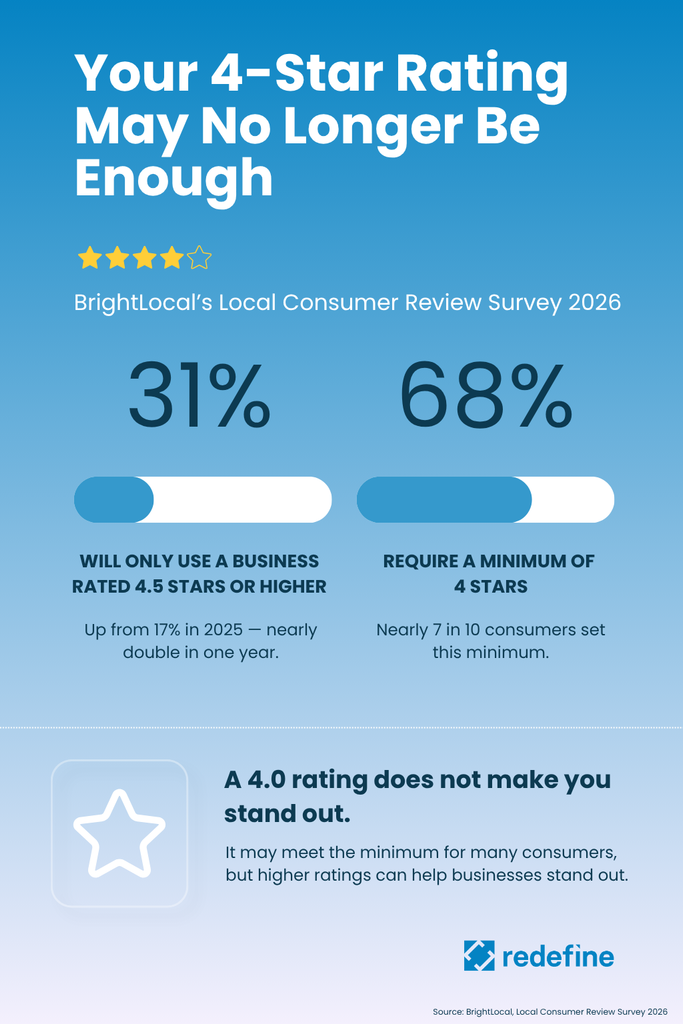
BrightLocal’s Local Consumer Review Survey 2026 found that 31% of consumers will only use a business rated 4.5 stars or higher. That is nearly double the 17% who said the same a year earlier. Another 68% require a minimum of 4 stars. So a 4.0 rating does not make you stand out. It makes you the floor. You are barely qualifying, not leading the pack.
The volume problem makes this worse. BrightLocal’s research also shows that 59% of consumers say a business needs between 20 and 99 reviews before they trust its star rating at all. The average consumer reads around 10 reviews and spends close to 13 to 14 minutes evaluating a local business before making a decision. A business with a 4.2-star average and 11 reviews is not more trustworthy than a competitor with a 4.0 average and 85 reviews. The math does not work that way in a searcher’s mind.
From a local SEO perspective, the picture is just as clear. According to Whitespark’s Google Business Profile Reviews Guide (2026), 5 of the top 10 conversion factors in local search are review-related. Four of the top 20 Google ranking factors involve reviews: high numerical rating, high number of reviews, a sustained influx of reviews over time, and having recent reviews. A star rating is just one of those four. The other three are about behavior and momentum, not a number.
For home service businesses competing in categories like HVAC, plumbing services, pest control, and general contracting, this matters more than in almost any other vertical. These are high-stakes, high-trust purchases. A homeowner calling someone to fix a burst pipe or rewire a panel is not going to settle for “probably fine.” They are going to look hard at the full review picture before they dial.
Review Velocity: How Often You’re Getting Reviews Matters

Review velocity is the rate at which new reviews arrive on your Google Business Profile. It is not about your total count. It is about whether that count is growing, and how consistently.
Google’s local algorithm treats a steady stream of incoming reviews as a signal that a business is active, relevant, and trusted by real customers right now. Local Falcon’s analysis of Google’s local ranking signals confirms that review velocity is a confirmed factor in Google’s local algorithm, alongside review quantity, recency, and positive sentiment.
A business generating two to three new reviews per week sends a very different signal than one that earned 80 reviews two years ago and has been quiet since. According to Power Digital Marketing’s summary of Moz’s Local Search Ranking Factors survey, review signals (which include review quantity, review velocity, and review diversity) make up one of eight core ranking factor categories for local search. It sits alongside on-page SEO, link building, and Google Business Profile signals as a pillar of local ranking, not a secondary consideration.
The practical implication for home service businesses is this: a competitor with a 3.8-star average who pulls in consistent new reviews every week can outrank and out-convert a business sitting at 4.1 stars with a review profile that went cold six months ago. The lower-rated business looks active. The higher-rated one looks abandoned.
What Drives Velocity for Home Service Businesses
Velocity does not happen by accident. The businesses that maintain it have a system. After every completed job, whether it is an HVAC tune-up, a drain cleaning, or a pest control treatment, there is a process in place to ask for a review. That might be a text message sent within an hour of job completion, a follow-up email the same evening, or a technician asking the homeowner before they leave.
The ask has to be frictionless. A direct link to the Google review form removes every barrier between a satisfied customer and a posted review. Businesses that make the customer hunt for where to leave a review lose most of them before they get there.
Review generation is not a marketing tactic you run once. It is an operational habit that has to be built into every job, every day.
Review Recency: When Your Reviews Were Left
Recency is the signal most home service businesses underestimate, and it is the one that can quietly kill a strong review profile.
BrightLocal’s Local Consumer Review Survey 2026 found that 74% of consumers only care about reviews written in the last three months. That is not a preference. That is a hard cutoff for nearly three-quarters of your potential customers. A glowing review from 18 months ago does not reassure them. It raises a question: what happened since then?
The same survey found that 47% of consumers will not use a business that has fewer than 20 reviews. Put those two findings together and the picture is clear: a business needs a meaningful volume of reviews, and those reviews need to be recent. One without the other is not enough.
How Recency Affects Local Search Rankings
Review recency is not just a trust signal for humans. It is a ranking signal for Google. Review signals, including how many reviews a business has, how recent they are, the star rating, the response rate, and keyword mentions in review text, are confirmed as a top-three local ranking factor. TTG Creatives’ analysis of Moz’s Local Search Ranking Factors data notes that recency has gained more weight in the 2024 to 2025 period.
The mechanism makes sense. Google’s goal is to surface businesses that are currently active and currently trusted. A review profile that stopped growing signals the opposite. It suggests the business may have changed ownership, declined in quality, or simply stopped caring about its online reputation. None of those interpretations help your search rankings.
For contractors, HVAC companies, and other home service businesses with seasonal demand patterns, recency is especially vulnerable. A roofing company that gets flooded with reviews after storm season and then goes quiet for six months is handing that recency advantage back to competitors who kept asking through the slow period.
The Recency Gap Most Businesses Don’t Notice
Here is what makes recency dangerous: it erodes silently. Your star average does not change. Your review count does not drop. Everything looks fine on the surface. But the date stamps on your most recent reviews keep drifting further into the past. Every week that passes, a larger share of your reviews falls outside the three-month window that most consumers actually read.
By the time you notice the problem in your call volume or your local pack position, you have already lost ground that takes months to recover.
Response Strategy: How You Reply to Reviews
Responding to reviews is the most underused lever in local search for home service businesses. Most businesses either do not respond at all, or they respond inconsistently, thanking five-star reviews with a generic “Thanks for the kind words!” while ignoring everything else. Neither approach is a strategy.
BrightLocal’s 2024 Local Consumer Review Survey found that 88% of consumers would use a business that replies to all of its reviews, compared to just 47% who would use a business that does not respond at all. That is a 41-point gap in consumer willingness, driven entirely by whether you reply.
Response time matters too. BrightLocal’s 2026 data shows that 19% of consumers expect a same-day response to their review (up from 6% in 2025), 32% expect a next-day response (up from 18% in 2025), and 81% expect a response within a week. Consumer expectations around response time are accelerating. A review that sits unanswered for two weeks is a visible signal to every future searcher who reads it.
What Google Says About Review Responses
Google’s Business Profile Help explicitly states that responding to reviews shows you value customer feedback, and that “positive reviews and helpful replies can help your business stand out,” listing review response as a direct tip to improve local ranking. This is not an interpretation. Google names it as a ranking input.
Google’s guidance on how to respond advises keeping replies short and simple, staying professional, avoiding acting as a salesperson, and giving helpful responses to negative reviews. Google also cautions against sharing a reviewer’s private information or attacking them personally. The goal is to show engagement and good faith, not to win an argument.
What a Strong Response Strategy Looks Like
A strong review response strategy for home service businesses covers three scenarios: positive reviews, neutral reviews, and negative reviews.
Positive reviews: Acknowledge the specific service mentioned, thank the customer by first name if they used it, and add one sentence that reinforces your service area or a related service. Keep it under three sentences. Do not copy-paste the same response to every five-star review. It reads as automated and erodes the social proof value of the exchange.
Neutral reviews (3 to 4 stars): These are the most valuable responses you can write. A thoughtful reply to a mixed review shows future customers that you take feedback seriously and that you are willing to make things right. Acknowledge the specific concern, explain what you have done or will do, and invite them to reach out directly.
Negative reviews: Do not go defensive. Do not match the tone. Acknowledge the experience, apologize for falling short, and move the conversation offline with a direct contact. A calm, professional response to a 1-star review is one of the strongest trust signals you can display to a prospective customer reading through your profile.
The businesses that respond well to negative reviews often convert more skeptical searchers than businesses with perfect ratings. It is counterintuitive, but it reflects how people actually evaluate trust: not by looking for perfection, but by looking for accountability.
The Signals That Actually Separate the Business That Gets Called
Let’s put the full picture together, because velocity, recency, and response strategy do not operate in isolation. They compound.
A 2026 WebFX study of 500 home services searches found the local pack appeared in 488 of them, a 97.6% appearance rate. The local pack is not a feature that sometimes shows up in home services searches. It is the dominant format. And according to Red Local Agency’s Google Local Pack Statistics, 44% of local searchers click local 3-pack results, compared to 29% for organic results and 19% for paid results. The local pack is where the clicks live.
Position matters inside the pack. The number one position receives 17.6% of click-throughs, position two receives 15.4%, and position three receives 15.1%. Businesses in the 3-pack receive 93% more conversion-oriented actions (calls, website clicks, driving directions) than businesses ranked in positions 4 through 10. The difference between being in the pack and being just outside it is enormous.
According to BrightLocal’s analysis of Google’s local ranking factors, review signals now account for 20% of local pack and Google Maps ranking factors, up from 16% in 2023. That makes them the second most important ranking factor group for local pack visibility. On-page SEO, local citations, NAP consistency, and link building all matter. But reviews are the factor that most home service businesses have the most direct control over and the most room to improve.
The business that gets called is not necessarily the one with the highest rating. It is the one whose profile communicates: we are active, we are trusted by recent customers, and we take our reputation seriously.
- Velocity says you are busy and people keep choosing you.
- Recency says those customers are current, not historical.
- Response strategy says you are engaged and accountable.
Together, those three signals create a profile that a searcher trusts before they have even visited your website. The business that gets scrolled past has the inverse profile: a decent star average, reviews that stopped coming in months ago, and a response section that is either empty or filled with copy-pasted thank-you notes. It looks like a business that used to be good. That is not a compelling reason to call.
Need Help with Marketing Your Home Service Business?
Redefine Marketing Group is here to help. We recently helped Rocket Plumbing get over 2,100 phone calls in a single year with organic marketing. Growing your brand online isn’t impossible. With the right strategies in place, we can help you earn more reviews and make more use out of the reviews you earn. Click here for a free consultation.