


Search engine optimization (SEO) is the process of improving your website so that it appears in search results on Google and other search engines. When done right, it’s a powerful engine for business growth. In fact, 49% of marketers report that SEO has the best ROI of any digital marketing channel.
But what actually is SEO, and how does it work? The term SEO gets thrown around a lot, but it’s often mired in misconceptions. Some marketers make SEO sound like an instant growth hack, while others position it as an exhausting game of cat-and-mouse where you’re at the whim of some elusive algorithm. The truth is that SEO is neither.
At its core, SEO is a fundamental shift in how you communicate your business’ value to potential customers, stakeholders, and industry peers. It’s part creative content, part technical strategy, and always evolving. SEO unlocks your ability to be discovered by people who are looking for your product or service – whether they already know your brand or not.
Here at Redefine Marketing Group, we live and breathe search engine optimization. But we know it can be daunting to cut through the noise and actually learn how to do SEO. That’s why we’ve prepared this guide to answer the question, what is SEO?, once and for all.
What is SEO? (And what is it not?)
As we mentioned above, SEO is an element of SEM that’s all about optimizing your website to increase visibility in SERPs. The goal is to earn organic traffic. This means you are not paying for every click like you would with a PPC campaign.
SEM? SERPs? Organic traffic? PPC? If there’s one thing all SEO agencies agree on, it’s that our industry has a lot of acronyms and jargon. Before we dive deeper, let’s quickly review some key terms you should know:
Key SEO terms you should know
- SEO: Search engine optimization. (What this entire article is about!)
- SEM: Short for search engine marketing. An umbrella term that includes SEO, as well as PPC.
- PPC: Pay-per-click. A model of online advertising where you pay each time someone clicks on an ad to visit your site. Often used in conjunction with SEO.
- SERP: Search engine results page. When you look up something on Google or another search engine, the SERP is the page that shows all the links related to your query.
- Organic Traffic: The “earned” visitors who find your website through search engine results, rather than by clicking on paid advertisements.
- Keyword: The specific words and phrases people type into search engines to find what they need.
- Content: The actual information on your site (such as blog articles, white papers, case studies, glossaries, videos, or podcasts) that provides value to your audience.
- On-Page SEO: Refers to any optimizations done to your website.
- Off-Page SEO: Refers to any actions taken outside of your own website, such as earning backlinks or growing social media accounts, to build your authority or brand reach.
- Link Building: The strategic process of getting other reputable websites to link back to your pages.
We’ll touch on many of these concepts in more detail later on. But if you still get lost, check out our free SEO glossary for more info on these terms and others.
So now that you know what we’re actually talking about, it’s time to address the central question of what SEO actually means. Here’s what it is – and what it isn’t.
SEO is… a foundational business investment
Unlike social posts that are forgotten in hours or days, or PPC campaigns that require continual spending, SEO is a foundational investment. It grows in value over time. When your website is properly optimized, your content can rank (and keep bringing in customers and leads) for years.
SEO is… a way to capture interest
When someone types a keyword into Google or another search engine, they may be looking for something specific or simply searching for general information. SEO places your brand in the right place to capture the user’s interest and bring them to your site to learn more, sign up, or complete a purchase.
SEO is… a commitment to user experience
Modern search engines prioritize the human experience. They reward websites that are fast, easy to navigate, and genuinely informative. When you optimize for search engines, you’re also making your user experience better for your actual customers.
SEO is NOT… just about keywords
As the above implies, today’s search engine optimization requires more than just adding the right keywords to your content. Modern search engines (especially AI platforms like ChatGPT and Gemini) understand context, synonyms, and the user’s underlying intent. In other words, SEO requires quality, originality, and expertise. Not just keywords.
SEO is NOT… a one-time task
SEO is not a one-off project. It is more like a garden that needs regular care. As competitors and algorithms evolve, you must keep tending your site to prevent technical errors and outdated content from hurting your visibility.
SEO is NOT… a cheat code
Some so-called SEO “experts” claim to know weird tricks or hacks to cheat the algorithm, but the truth is that there’s no magic bullet for ranking higher on SERPs. SEO isn’t about cheating. It’s about creating real value that search engines feel confident recommending to users.
SEO is NOT… instant
We like to say that SEO is a marathon, not a sprint. Although there are many SEO techniques that can deliver quicker wins – such as striking distance optimizations or resolving various technical issues – it’s not an overnight process. Search engines need time to crawl, index, and build trust in your content. Sustainable growth requires a solid foundation that takes time to develop.
Why SEO matters for your business
Whether you’re a small startup or an established enterprise, your business needs SEO. But why? The answer is simple. It’s because buying decisions are made on search engines. According to one estimate, 73% of all purchases start with a search on Google. This includes both B2C and B2B purchases.
When a potential customer consistently sees your brand show up in the top results for their query, it sends a powerful psychological signal. A high ranking on SERPs says that you’re a leader in your field. It says your products or services are the best. And let’s face it – most folks don’t click past page one. So if you’re not ranking, you’re losing out.
SEO also makes an impact for businesses because it allows people to discover your brand at the exact moment they need it. Searching is active. Unlike passive marketing such as billboards or social media ads, SEO puts your website in front of potential customers who want to find you or your products and services. It’s a powerful way to increase conversions and generate more qualified leads.
An investment that pays off
Here’s another way to think of SEO: imagine it’s a high-yield savings account. The work you do today adds to the total equity of your website. Over time, that equity earns interest in the form of higher rankings and more traffic.
We’ve seen this play out, time and time again, with clients across a variety of different industries.
For example, our client IGeneX experienced 55% revenue growth after a successful SEO campaign. When they originally approached Redefine, the client had a solid website with strong domain authority, but they weren’t ranking very highly for critical keywords. We helped the client with on-page SEO implementations, technical fixes, and a more robust content strategy that targeted high-value keywords in their niche.
Our efforts grew the client’s organic traffic by 65%, driving their revenue growth by generating more qualified leads and customers.
How SEO and search engines work
So now that you understand what SEO means and why it’s important, let’s talk about how it works.
It all starts with our constant digital companion, the not-so-humble search engine. Generally, this means Google. Google dominates the world of search, with its market share estimated to hover around 90% worldwide. Google is so huge, in fact, that it’s reportedly the #1 most searched term on Microsoft’s rival search engine, Bing.
That’s why most SEO efforts focus on Google. But don’t worry about putting too many eggs in one basket. The SEO techniques that make your website a hit on Google will also help it rank on other search engines.
Understanding how search engines work – beyond the basics – is critical to understanding SEO. That’s because all SEO is tailored to navigate the various algorithms, features, and rules of search engines.
We’ve all experienced search engines as a user. You enter a term, hit return, and scroll until you find an interesting link to click. But here’s what goes on behind the scenes:
Crawling: The discovery phase
Search engines use bots to scour the web. These digital spiders move from link to link to find new pages. If your site structure is messy or has technical errors, these bots might leave your site immediately or never discover you exist. But when your site is solid, the bots stick around and move onto indexing.
Indexing: The filing phase
After discovery, bots analyze your website’s text and images to understand your content and what it’s about. They store this data in a massive digital library called an index. Fun fact: When you search, you’re actually browsing this stored library rather than the live internet. (And the lag-time between changes to your site and changes to the index is another reason why SEO is a long game, rather than an overnight quick fix.)
Ranking: The final phase
Finally, when a user asks a question, the search engine sifts through its index to find the most relevant and high-quality answers. It uses hundreds of different factors to decide the order of results. SEO is the process of proving your page is the best choice for that search.
The three core pillars of SEO
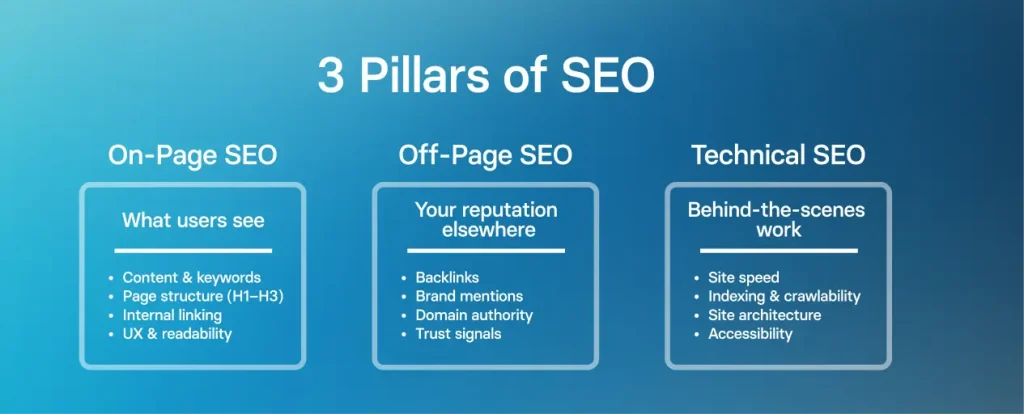
Search engine optimization includes many different techniques and processes. To keep it simple, we break it down into three core pillars. You don’t have to do everything all at once, but any SEO campaign should cover a few vital elements of each category.
1. On-Page SEO: What users see on your site
As the name implies, on-page SEO covers everything on the pages of your website. On-page SEO practices directly impact how search engines understand and rank your site. This starts with high-quality content that matches the user’s search intent, with thorough keyword research, then includes other optimizations on-page elements.
Keyword research
Keyword research is the foundation of this pillar. It is the process of identifying the exact words and phrases your audience uses when they have a problem. By analyzing search data, we can see exactly what people are looking for and how much competition exists for those terms.
At Redefine, we look for a balance between short tail keywords (also known as head terms) and long tail keywords. Short tail keywords are broad and high volume, while long tail phrases are more specific. Long tail keywords may have lower search volume, but they often have higher conversion rates. For new sites, it’s often easier to rank for long tail keywords because there’s less competition, too.
Once we have our keywords, we place them naturally in title tags, meta descriptions, and headings. We also ensure the body content is substantive, easy to read, and matches search intent.
Search intent
Search intent is a qualitative metric that describes the purpose of the user’s query. It’s broken down into the following four categories:
- Navigational: The user is looking for a specific web page
- Informational: The user is looking for general information
- Commercial: They’re interested in purchasing a product or service, but they’re still researching and may not be ready to hit “buy now” or “sign up”
- Transactional: The user has made their decision and they’re ready to complete a transaction
All keywords are assigned a search intent. When you’re trying to get your pages to rank for those keywords, you need to make sure your content aligns with the intent. For example, if someone searches for “how to choose a CRM,” they want a guide, not a product landing page.
Other on-page optimizations
On-page SEO goes beyond the words you read. It includes the labels and signs that help both users and bots navigate your site. Title tags and meta descriptions drive clicks, while internal links connect your content to build a clear hierarchy. Even small details like image alt text and headings improve accessibility.
Together, these elements prove to search engines that your site is organized and valuable.
2. Off-page SEO: Your reputation elsewhere on the web
If on-page SEO is what you say about yourself, off-page SEO is what the rest of the world (or at least the rest of the internet!) says about you. Why does this matter? First, on a user-level, your reputation can positively or negatively affect your business. Second, it affects how much “weight” the search engine algorithms give your site. This is known as domain authority.
When you have a higher domain authority, it’s much easier for your website to rank for high-volume, high-competition short tail keywords. One of the best ways to build domain authority is to get other websites to link to yours. These links, known as backlinks, act as a virtual vote of confidence and help your site appear more trustworthy for both algorithms and users.
However, not all links are created equal. One link from a highly reputable industry publication carries far more weight than thousands of obscure, low-quality blogs. In fact, “spammy” links can actually damage your reputation with search engines. This is why we focus on earning “healthy” links through hyper-relevant content production. After all, you can’t just ask for trust and authority. You have to create content that earns it.
These high-quality pieces are called linkable assets. At Redefine, we saw this strategy pay off significantly in our work with cybersecurity leader HYPR. By developing substantive blog posts that solved real problems for their audience, we were able to pitch to over 10,000 niche publications.
The results were transformative. HYPR saw a 48% increase in referring domains and a 102% increase in total backlinks. This proves that when you provide genuine value, building authority becomes a natural part of your growth.
Social media and review sites
Off-page SEO also encompasses your broader digital footprint, including social media and review sites like Yelp or Google Business. While a LinkedIn share or a positive review is not a direct ranking factor in the same way a backlink is, these signals are vital for trust.
When your brand is discussed positively on review platforms and shared across social networks, it tells search engines that you are a legitimate, active, and trusted entity.
3. Technical SEO: The behind-the-scenes work
The final pillar is technical SEO. Technical SEO ensures that your website is easy for search engines to crawl and index. It also focuses on the technical side of the user experience.
For example, if your site takes ten seconds to load, most users will leave before they ever see your content. Search engines notice this low engagement rate and will penalize your rankings as a result.
Key technical elements include site speed, mobile friendliness, and secure connections (HTTPS). Technical SEO also involves organizing your site architecture so that both users and bots can find their way around without getting lost in a maze of broken links or confusing menus.
Modern SEO: Content and the human experience
In the early days of SEO, people wrote for robots. They would stuff their pages with keywords and follow rigid formulas to rank. Today, that approach no longer works. Modern SEO is about providing a stellar experience for human readers while giving search engines the signals they need.
E-E-A-T
Google uses a framework called E-E-A-T (Experience, Expertise, Authoritativeness, and Trustworthiness) to evaluate content. They want to reward writers who actually know what they are talking about. This is why human writing still matters so much. AI can summarize existing information, but it lacks a clear voice and perspective.
To rank well today, you need to bring an original “take” to the table. You need to show your work and prove that you’re a reliable source of information. You have to recognize if a user is just starting their research, or if they are stressed and need an immediate solution, and everything in between. Your content should be accurate and informative, yet engaging.
Core Web Vitals
In recent years, Google has also become much more explicit about the technical side of user experience through a set of metrics called Core Web Vitals. Core Web Vitals measure factors like how quickly the largest element on a page loads and whether the layout shifts unexpectedly while a user is reading.
As we’ve discussed with user experience, SEO is no longer just a marketing discipline. It’s a design and development discipline as well.
Can you do DIY SEO?
Yes! Getting started with SEO doesn’t require a computer science degree or decades of content writing experience. Basics like writing a blog and optimizing your website’s meta titles and descriptions are relatively easy tasks for beginners.
However, as your business grows, SEO becomes increasingly complex. A DIY approach often hits a ceiling for several reasons. Professional SEO tools for deep data analysis are expensive and complicated. Plus, content creation and technical maintenance are full time jobs. It’s also difficult to stay current with every algorithm update, especially when you’re also running your business.
That’s why partnering with an SEO agency like Redefine is a smart choice. An agency can offer a custom roadmap that aligns with your specific business goals. If you’re considering hiring help, you should ask about their process for strategy and their approach to transparency. (Note: If you’re thinking of outsourcing SEO, learn about the differences between U.S.-based and overseas agencies to help you make an informed decision.)
SEO checklist for getting started
But if you want to take a look at your own site today, here’s a practical checklist to guide your efforts:
- Audit Your Technical Basics: Use a tool like PageSpeed Insights to see how fast your site loads.
- Claim Your Google Search Console: This free tool tells you exactly how Google sees your site and if there are any errors.
- Identify Your Core Pages: Which five to ten pages are most important for your business? Are they optimized for clear, relevant keywords?
- Check Your Mobile Experience: Open your site on your phone. Is it easy to click buttons? Is the text large enough to read?
- Look for Content Gaps: What questions are your customers asking that your website has not answered yet?
The Redefine approach to SEO
At Redefine, we don’t believe in “one size fits all” SEO. We don’t use templates, and we don’t chase vanity metrics like “total traffic” if that traffic isn’t actually converting into customers.
Our approach is strategy-first. We start by understanding your business, your buyers, and your competition. From there, we build a custom roadmap that focuses on the highest impact activities. We believe in total transparency and collaboration. You should always know exactly what we are doing and why we are doing it. Our goal is not just to get you to rank. It’s to help you grow. Learn more about our philosophy on our SEO services page.
Frequently asked questions about SEO
How long does SEO take to work?
Generally, you can expect to see meaningful results within four to nine months. This varies based on the competitiveness of your industry and the current health of your website. It’s a gradual build rather than a sudden spike.
Is SEO worth it for small businesses?
Absolutely. In fact, SEO is one of the best ways for a small business to compete with much larger corporations. While a big company can outspend you on ads, they can’t buy the trust and relevance that comes from high quality, helpful content.
How much does SEO cost?
Pricing varies depending on the scope of work. Beware of “cheap” SEO packages that only cost a few hundred dollars because these often involve automated tactics that can actually hurt your site in the long run. At Redefine, we offer multiple affordable SEO packages as well as one-time service bundles and custom contracts. Learn more here.
How do you measure SEO success?
We look at a variety of metrics, including organic traffic growth, keyword rankings, and backlinks. But most importantly, we look at conversions. High rankings are only valuable if they lead to phone calls, contact form submissions, sales, or other goals defined by your business.